Space Data Centers: The Strategic Logic Behind Computing Beyond Earth

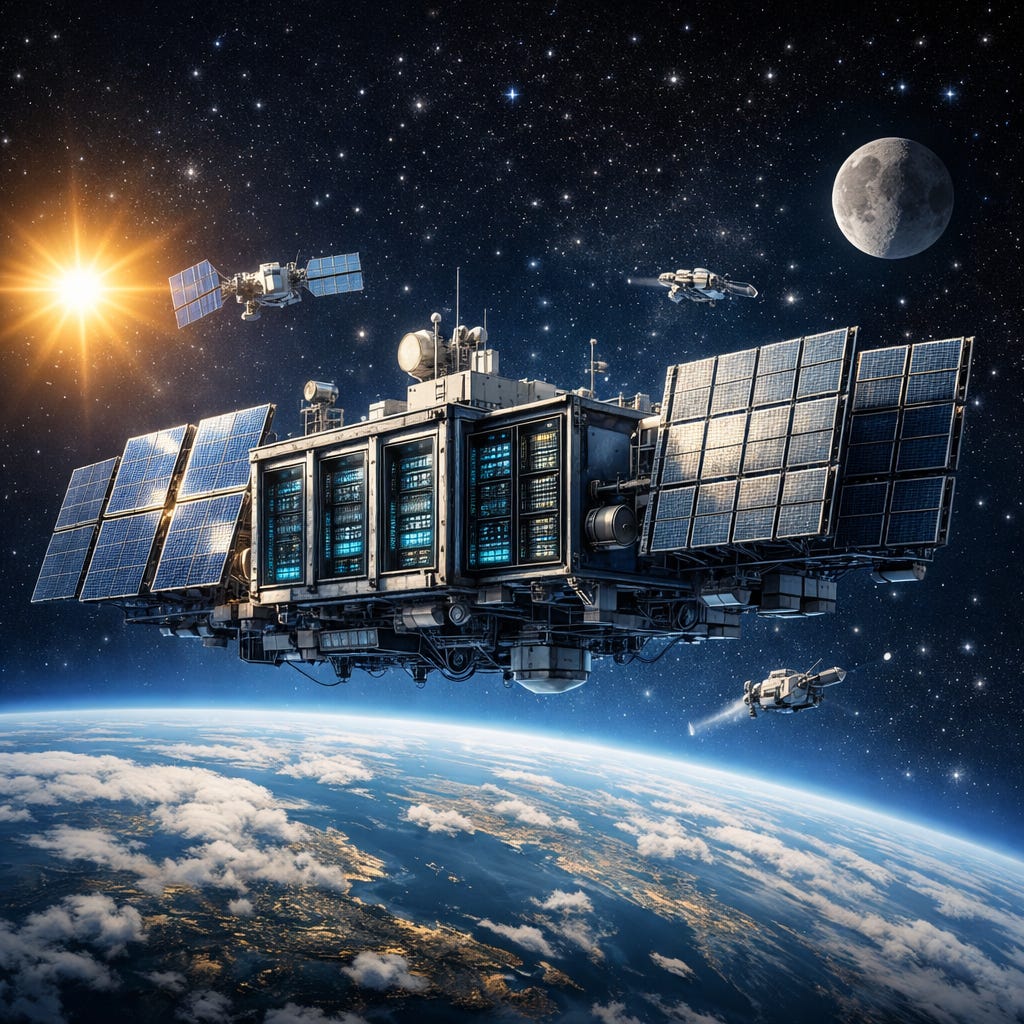
As artificial intelligence scales, the world is being forced to confront a simple but increasingly uncomfortable reality: computation is no longer a lightweight digital abstraction. It is physical. It consumes land, power, water, cooling capacity, and capital at enormous scale. What once looked like a background layer of the internet is now becoming a core industrial system of the modern economy.
Data centers sit at the heart of this transformation. They power cloud services, financial systems, enterprise software, streaming platforms, military communications, and increasingly, the training and inference workloads that define the AI era. As demand for compute accelerates, the constraints surrounding traditional terrestrial data centers are becoming more visible. Electricity bottlenecks are intensifying. Cooling requirements are rising. land use conflicts are growing. Environmental scrutiny is becoming harder to ignore.
Against that backdrop, the idea of placing data centers in space, once the domain of science fiction, has begun to attract serious attention. At first glance, the concept appears almost absurd. Why would anyone launch servers into orbit when building them on Earth is already difficult enough? But when examined through the lens of infrastructure, energy, and long-term strategic capacity, the idea becomes more coherent than it first appears.
This is not because space data centers are immediately practical. They are not. The current cost, engineering complexity, and operational risks remain enormous. But as a long-duration strategic concept, they reveal something important: the next frontier of computing may not be defined only by faster chips or larger models, but by where and how compute infrastructure itself is physically deployed.
The appeal of space data centers begins with the most obvious operational challenge in modern computing: heat.
Every major compute system generates thermal stress. As processors perform increasingly dense workloads, especially in AI training clusters packed with advanced GPUs and accelerators, cooling becomes not just a cost center, but a central architectural constraint. On Earth, this has led to elaborate mechanical cooling systems, liquid cooling approaches, and in many cases, heavy dependence on water-intensive infrastructure. Cooling is one of the main reasons data centers are expensive to operate and politically contentious to expand.
In space, the thermal environment is radically different. That does not mean cooling becomes easy in a simplistic sense. Space is not a cold breeze surrounding a server rack. Heat cannot simply be dissipated through air in the way it is on Earth. Thermal management in orbit is a complex engineering problem involving radiation rather than convection. Yet that is precisely why space opens the door to a different design logic. Instead of constantly fighting atmospheric and terrestrial conditions, a space-based system could be engineered from the ground up around the realities of the orbital environment.
That possibility matters because future compute demand is likely to make thermal efficiency even more important. As AI systems scale, heat is not a secondary problem. It is one of the main limiting factors on density, energy efficiency, and total operating cost. If a new infrastructure model offers a structurally different path to thermal management, it deserves attention even if it remains years away from commercial viability.
The second major attraction is energy.
Data centers are, in essence, electricity conversion systems. They transform power into computation. As such, their long-term economics depend heavily on reliable and abundant energy access. On Earth, this creates familiar constraints. Electricity pricing varies by region. Grid reliability differs widely. Renewable energy supply is intermittent. Permitting is slow. High-capacity transmission is often difficult to build. Even where power is available, scaling rapidly enough to meet demand is another matter entirely.
Space changes the equation because solar generation behaves differently beyond the atmosphere. In orbit, solar panels are not affected by cloud cover, weather disruption, or many of the cyclical constraints that define terrestrial solar energy. Depending on the orbital architecture, exposure to sunlight can be significantly more consistent than on Earth. This creates the possibility of pairing energy-intensive compute infrastructure with a more stable solar energy environment.
That does not eliminate the engineering challenge of capturing, storing, and distributing that energy efficiently. Nor does it solve the question of how computation performed in space is integrated into terrestrial networks. But at the conceptual level, there is a compelling logic here: if the future economy requires far more computation, and computation requires large-scale energy, then placing compute infrastructure in an environment with direct and potentially continuous solar access becomes strategically interesting.
In this sense, a space data center is not just a server facility in orbit. It is better understood as a combined energy-and-compute platform. That distinction is important. Investors and policymakers often underestimate how tightly those two domains are becoming linked. The AI era is not simply a software story. It is increasingly an energy story, an industrial story, and an infrastructure story.
A third advantage lies in escaping the constraints of terrestrial land use.
Traditional data centers cannot be built just anywhere. They require access to power, connectivity, cooling resources, and politically feasible land. In many regions, these conditions are becoming more difficult to assemble simultaneously. Prime locations are limited. Real estate costs can be substantial. Local communities may resist large facilities due to concerns over noise, electricity consumption, water usage, and environmental impact. Even where governments are supportive, physical siting remains a real bottleneck.
This matters more than it may appear. The market tends to think of data center growth as something that can simply continue on a linear basis if capital is available. But physical infrastructure is never infinitely scalable. It runs into geography. It runs into regulation. It runs into social friction. It runs into grid limits.
A space-based computing platform offers a different kind of expansion path. It removes the conventional land constraint altogether. There is no real estate market in orbit in the same sense that exists on Earth. There are no local zoning boards. There are no neighborhood objections. This does not mean the system is frictionless. Orbital congestion, collision avoidance, debris risk, and space traffic management become their own complex set of constraints. But they are different constraints from those that dominate terrestrial infrastructure.
That distinction may become increasingly relevant if AI-driven compute demand continues rising faster than the physical expansion capacity of land-based facilities. In that case, even partial offloading of certain workloads into orbital infrastructure could become strategically valuable, not as a full replacement for terrestrial data centers, but as a supplementary capacity layer.
A fourth potential benefit is environmental pressure relief on Earth.
This point deserves nuance. A space data center would not automatically be environmentally superior in every respect. Launches are energy-intensive. Space hardware requires specialized materials and manufacturing. There would be a substantial environmental footprint associated with the creation and deployment of any such system. It would be naïve to describe orbital infrastructure as inherently green.
And yet, the environmental case becomes more interesting over time when viewed systemically rather than narrowly. Today’s data centers place large burdens on terrestrial energy grids and, in many cases, on local water systems. In drought-prone or resource-constrained regions, this is becoming an increasingly sensitive issue. Public opposition to data center expansion is not just about aesthetics or noise. It is often about resource competition.
If part of future compute demand could be shifted away from terrestrial grids and water-dependent cooling systems, that could reduce some of the strain now building around digital infrastructure expansion. The relevant question is not whether a space data center is perfectly clean. The relevant question is whether, under future launch economics and infrastructure maturity, it could become cleaner at the system level than continuing to concentrate every additional unit of compute on Earth.
That is a much more serious and useful question. As AI workloads continue to expand, sustainability will no longer be a branding issue. It will become a hard constraint on industrial growth. Any infrastructure model that offers the possibility of relieving terrestrial pressure will deserve close attention.
The fifth and perhaps most underappreciated advantage is strategic resilience.
Data centers are no longer merely commercial assets. They are now part of national and civilizational infrastructure. They support financial stability, defense systems, communications networks, public administration, industrial coordination, and increasingly, sovereign AI capability. To think of them as generic warehouse-style buildings is to misunderstand their geopolitical importance.
From that perspective, infrastructure resilience matters enormously. Terrestrial data centers remain exposed to natural disasters, grid failures, regional instability, sabotage, and war. Operators mitigate this through geographic redundancy, multi-region deployment, and distributed network architectures. But all terrestrial systems remain bound, in the end, to physical territory and terrestrial political risk.
A space-based data center introduces a different resilience profile. It would not be immune to risk. On the contrary, orbital infrastructure faces unique vulnerabilities including radiation exposure, debris impact, cyberattack, and anti-satellite threats. But it may still offer strategic diversification. In certain specialized applications, that alone could justify its existence.
For example, high-priority backup systems, sensitive government workloads, military support infrastructure, or ultra-secure data preservation models might eventually benefit from orbital deployment. In such contexts, the question is not whether space data centers are cheaper than conventional ones. The question is whether they offer forms of resilience or survivability that terrestrial systems cannot easily match.
Historically, strategic infrastructure has often followed this pattern. Railways, submarine cables, satellite networks, and nuclear systems were all initially expensive, technically difficult, and limited in application. But once states and major institutions recognized their strategic utility, investment accelerated despite short-term inefficiency. Space-based computing may ultimately belong in that category.
Still, this is where realism must return to the foreground.
The barriers to practical deployment are immense. Launch costs remain high, even if reusable rockets continue to reduce them. Hardware placed in orbit must be far more robust than hardware deployed on Earth. Maintenance is not a routine service call. Any failure becomes a major event. Replacement cycles are slow and costly. Systems must withstand radiation, vacuum, micrometeoroid risk, and long-term exposure to harsh operating conditions.
Latency is another serious challenge. Not every workload is well-suited to orbital processing. Many commercial applications depend on very low-latency interactions with users and systems on Earth. That means space data centers would likely need to be highly selective in the types of tasks they handle. They may be more appropriate for certain forms of batch processing, archival storage, specialized secure workloads, or compute functions where latency is less important than energy, isolation, or resilience.
This is why it would be a mistake to frame space data centers as a near-term replacement for terrestrial facilities. They are not. The more plausible view is that they represent a future niche with the potential to expand into something larger if the economics of launch, maintenance, energy capture, and network integration improve meaningfully over time.
Even so, the concept matters right now because it clarifies the direction of pressure inside the computing economy.
When ideas that once sounded fantastical begin to attract serious discussion, it is often a signal that the current system is approaching important limits. Space data centers are not interesting because they are imminent. They are interesting because they reveal how difficult it is becoming to scale compute within the familiar boundaries of land, water, electricity, and political tolerance on Earth.
In that sense, orbital data infrastructure is less a fantasy than a symptom. It is an expression of where modern computation is heading. We are entering a period in which digital growth increasingly collides with the physical world. The winners in the next phase of infrastructure may not simply be those with the best software or the most advanced semiconductors, but those who best understand the deeper industrial stack beneath computation itself.
That stack includes energy generation, thermal engineering, transmission systems, capital intensity, geopolitical risk, and site availability. It increasingly resembles the logic of heavy industry rather than the old mythology of weightless digital abundance. Space data centers sit at the outer edge of this realization, but they are still part of the same story.
The deeper question is not whether servers will soon float in orbit at global scale. The deeper question is whether the AI age will force a reorganization of computing infrastructure so profound that today’s terrestrial model begins to look incomplete. That possibility is no longer easy to dismiss.
For now, space data centers remain a long-duration concept rather than an investable mainstream reality. But long-duration concepts matter, especially when they illuminate structural constraints before the market fully prices them in. The rise of AI is not just a story about intelligence. It is also a story about power, heat, scarcity, and physical systems. And once those realities are taken seriously, the logic behind space-based compute becomes far easier to understand.
#SpaceDataCenters #AIInfrastructure #DataCenters #CloudComputing #OrbitalInfrastructure #SpaceEconomy #ArtificialIntelligence #ComputeDemand #EnergyInfrastructure #ThermalManagement #DigitalInfrastructure #FutureOfComputing #IndustrialStrategy #InfrastructureInvesting #StrategicResilience #Semiconductors #PowerAndCompute #OrbitalEconomy #TechnologyStrategy #StructuralAlpha